
Read the monthly ephemeris and declinations
List every body's daily position or declination for a month, with parallels, the void-of-course Moon, stations and ingresses.
3 min · 4 steps
- 1
Choose the month
Go to Western → Ephemeris & Declinations and choose the Month and Year. Positions are in the zodiac chosen in the header and are given for 0h UT each day; the times of the events below are in the chart's time zone, or in UTC when no chart is open.
- 2
Read the longitudes
Longitudes lists every body for each day of the month. ℞ marks retrograde motion, and SR and SD mark the day a planet stations retrograde or direct.
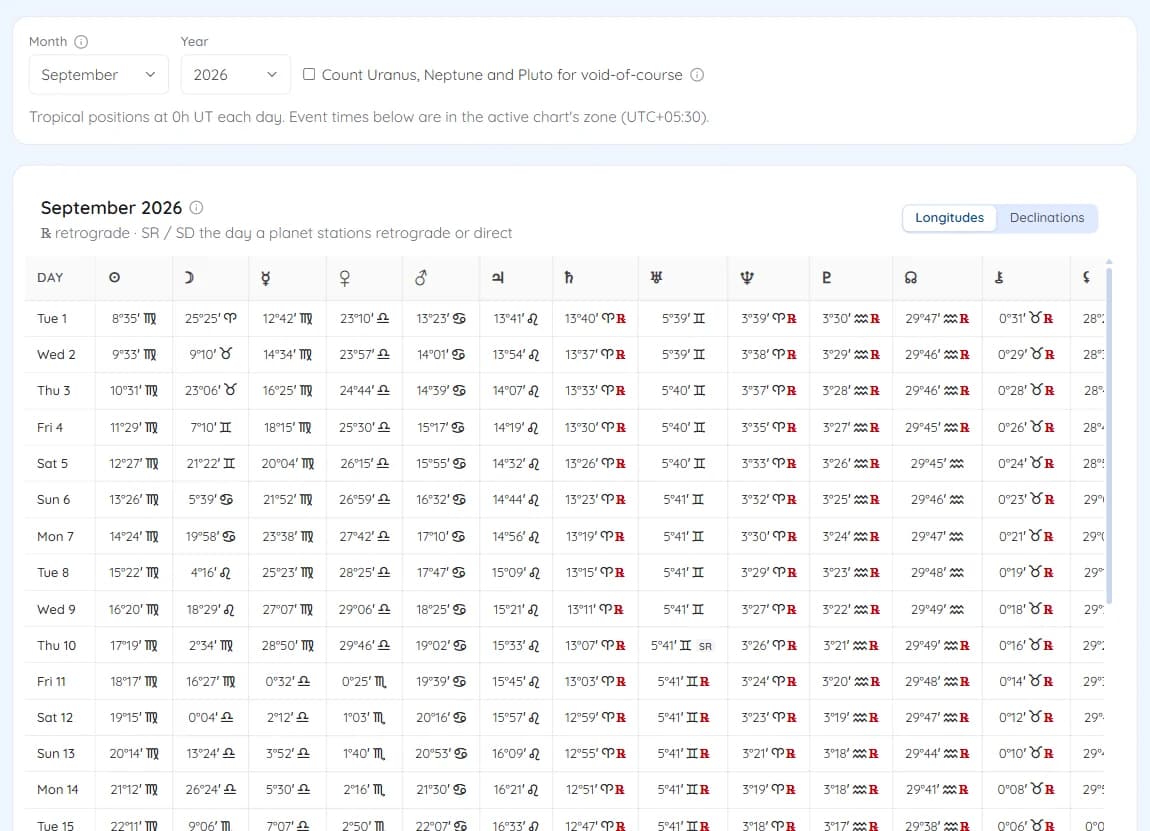
The monthly ephemeris with longitudes and a station - 3
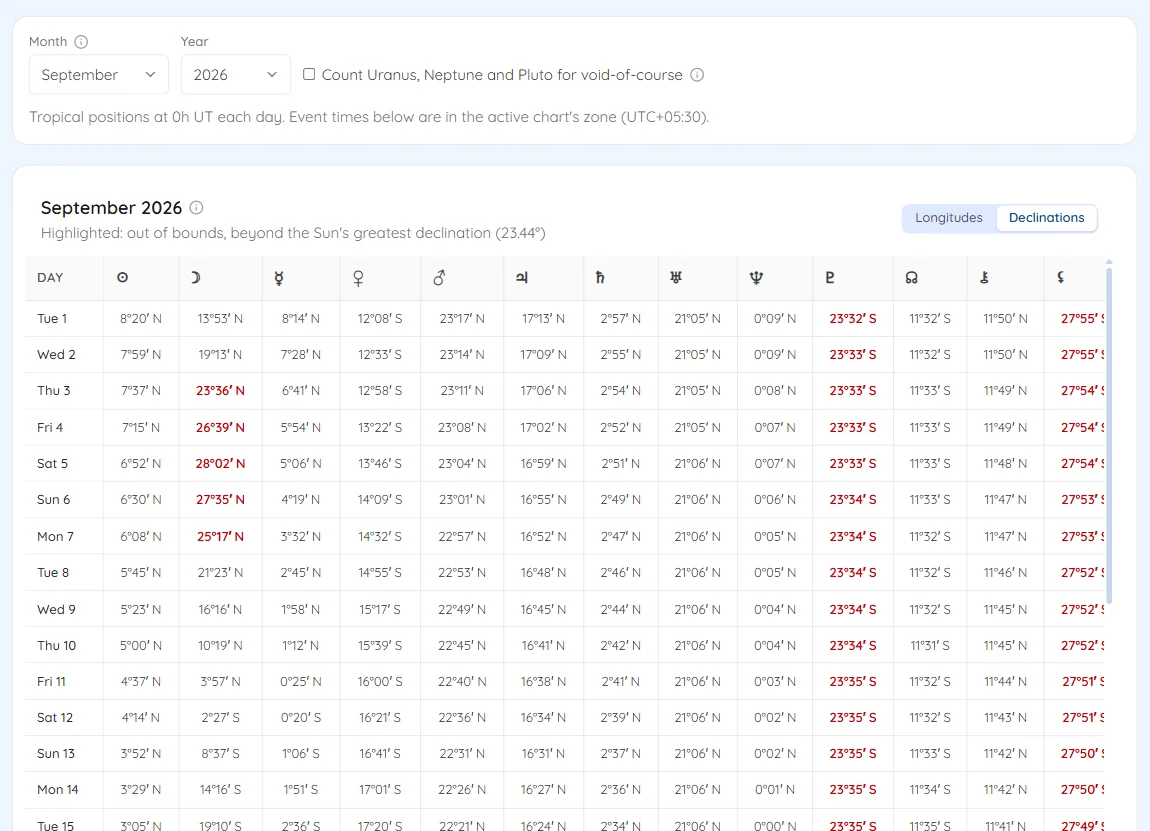
Switch to declinations
Declinations gives each body's distance north or south of the celestial equator. Values in red are out of bounds: beyond the Sun's greatest declination, shown above the table.
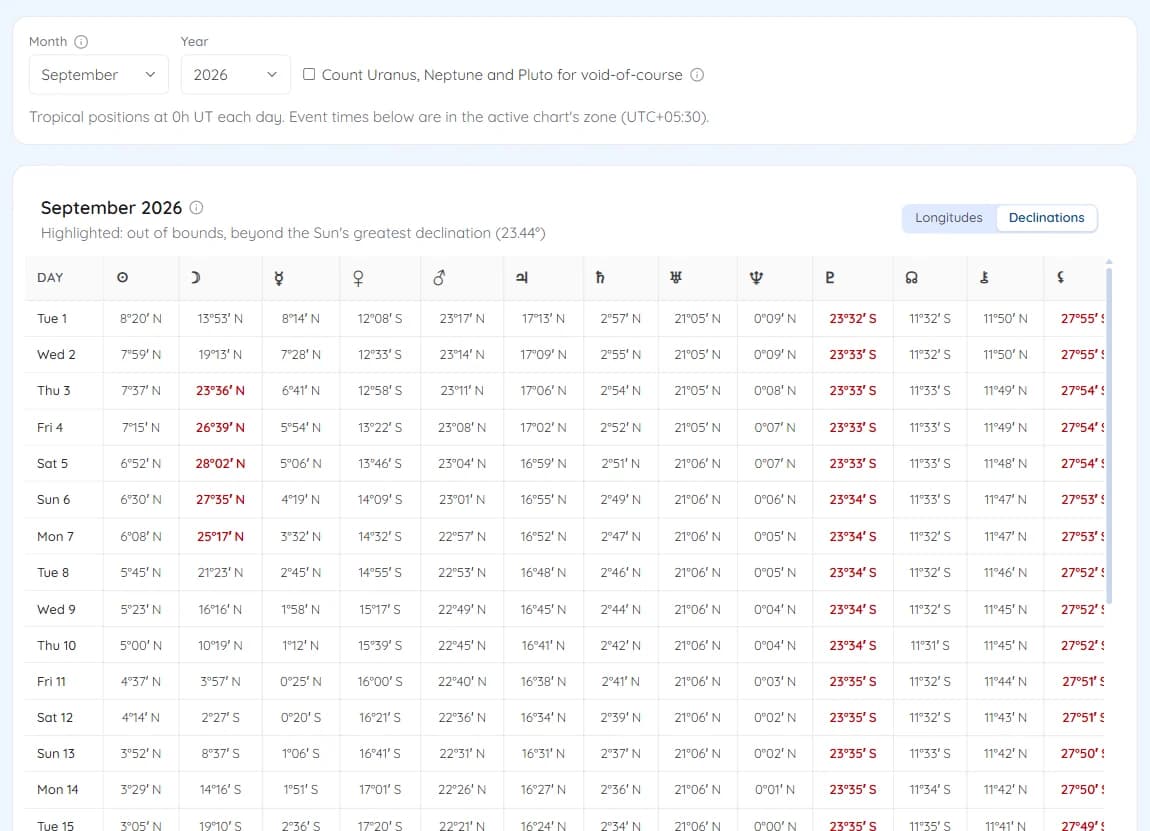
Declinations with out-of-bounds values in red - 4
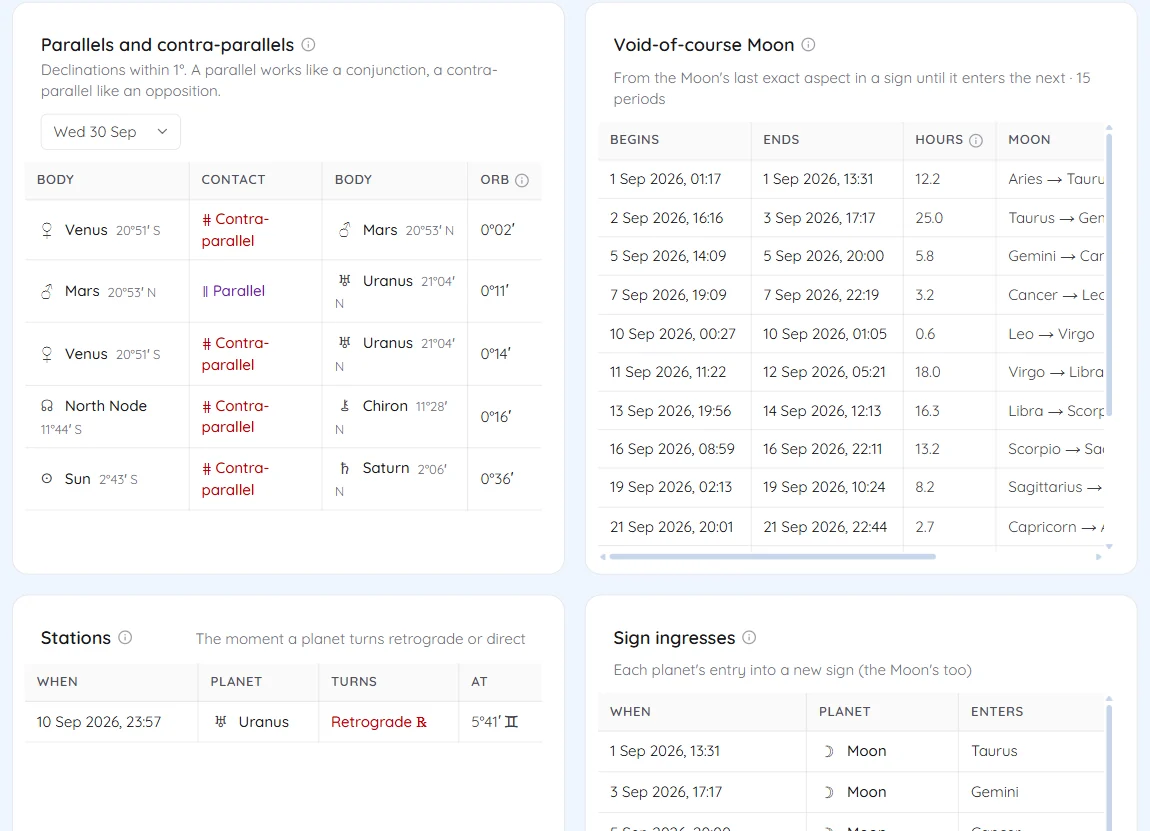
Check parallels, the Moon and the stations
Parallels and contra-parallels lists, for the day chosen in its menu, pairs within 1° of the same declination (a parallel) or of the same declination on the other side of the equator (a contra-parallel). A parallel is read like a conjunction and a contra-parallel like an opposition.
Void-of-course Moon lists each period from the Moon's last exact aspect in a sign until it enters the next. By default only the Sun to Saturn count; tick Count Uranus, Neptune and Pluto for void-of-course to add them. Stations and Sign ingresses give the month's turning points and sign changes.
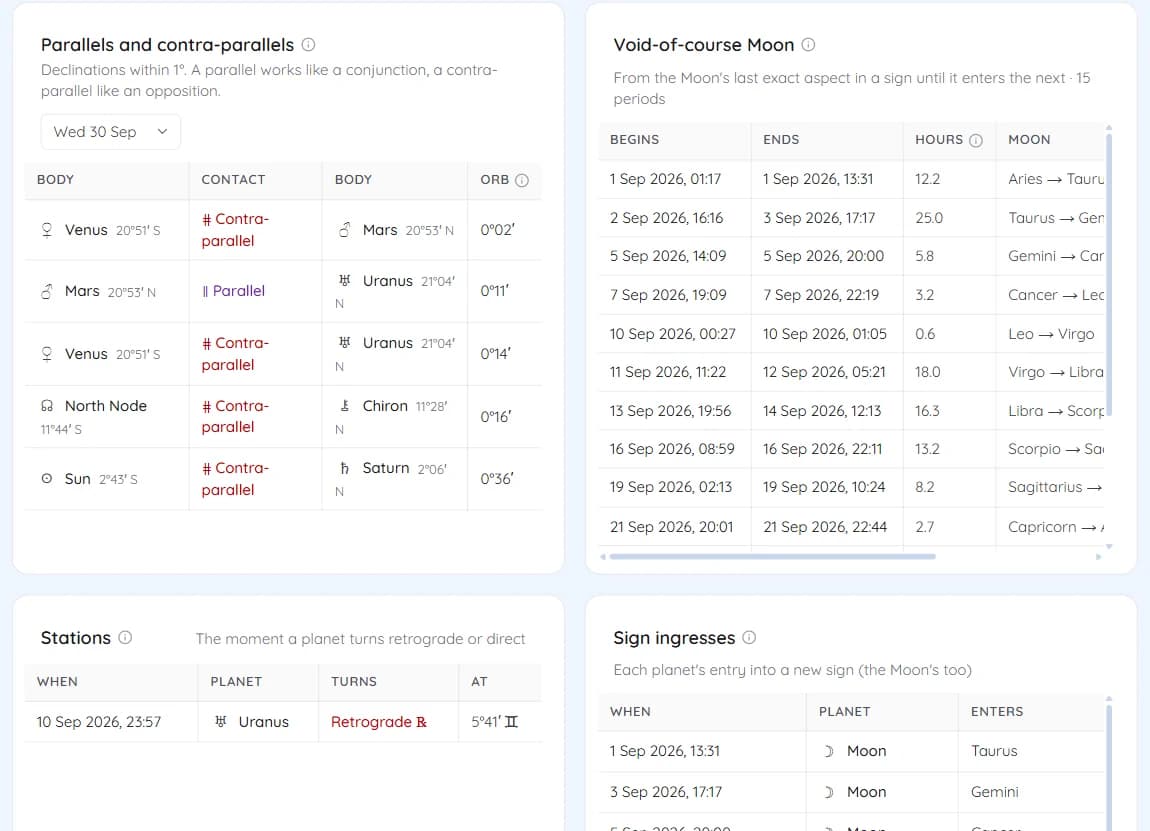
Parallels, the void-of-course Moon, stations and sign ingresses
Try it on your own chart
7 days free on any plan. Cancel before the trial ends and you pay nothing.